

What Is IPRN? International Premium Rate Numbers Explained
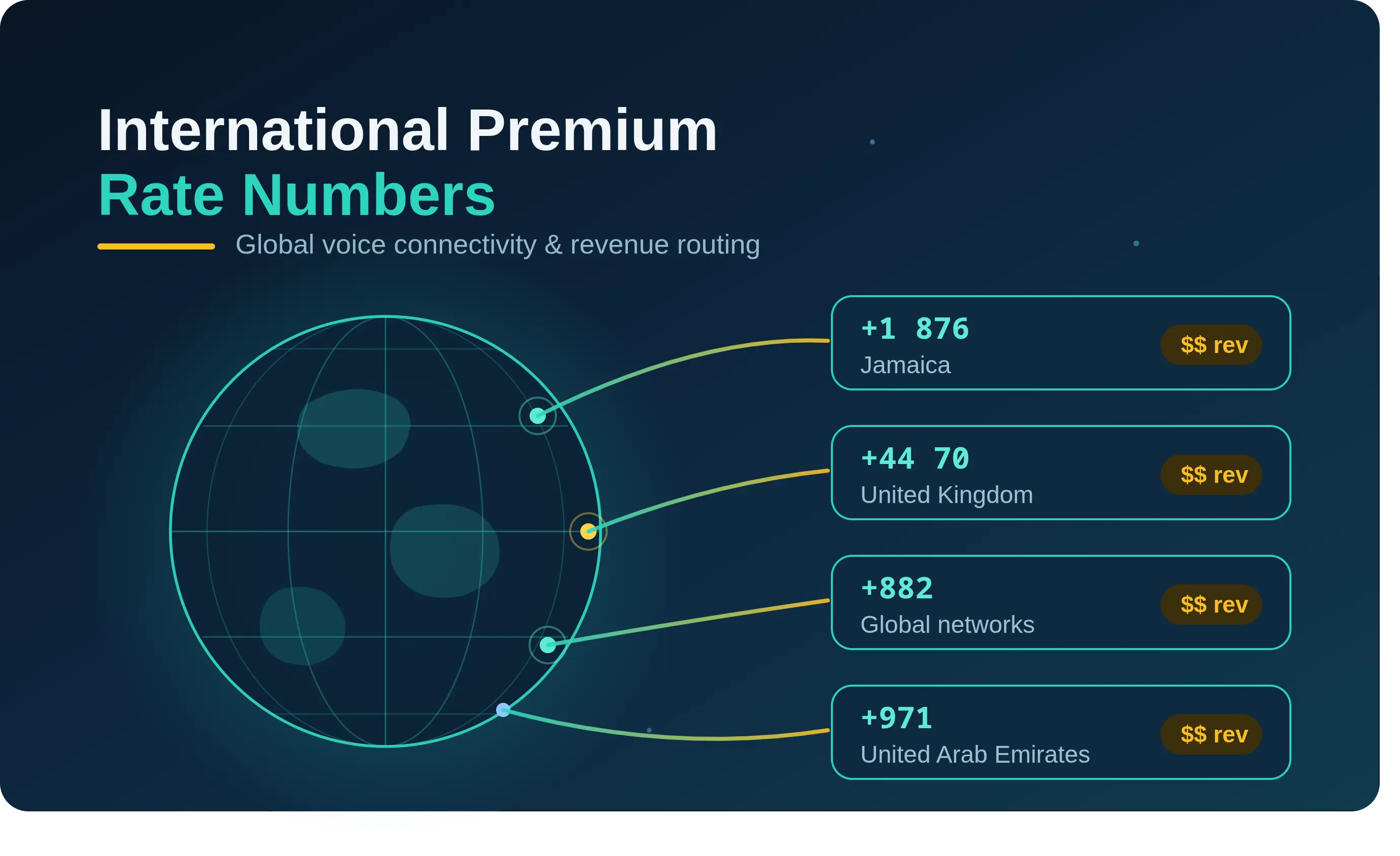
IPRN stands for International Premium Rate Numbers — telephone numbers that carry a charge above the normal call rate, where a share of that charge is paid back to the owner of the number. Unlike an ordinary phone number, an IPRN turns an inbound call into a revenue stream: the longer a caller stays on the line, the more revenue the service behind the number earns.
This guide explains what IPRN means, how the model works end to end, who the players are, what the numbers are used for, and how revenue is actually generated — written for people entering the wholesale side of the business, not just dialling one.
What does IPRN stand for?
IPRN is short for International Premium Rate Number. A premium rate number is any number billed above the standard call rate, with part of that premium paid to the service provider rather than kept entirely by the telco. The international part is what makes IPRN distinct: the number is reachable from many countries, not just the one where it was issued.
Most countries have their own domestic premium rate numbers (the classic examples are the "900" and "976" ranges in North America). The catch is that a domestic premium number can usually only be dialled from inside its own country. An IPRN sidesteps that limitation — it can be reached internationally, which is why it's widely used in regions where domestic premium-rate frameworks don't exist or are restricted.
At the formal level, the ITU defines the International Premium Rate Service (IPRS) and a universal format (UIPRN) under global country code 979, governed by ITU-T Recommendation E.155. In day-to-day wholesale, though, "IPRN" almost always refers to in-country number ranges across many destinations, accessed through carrier interconnections — which is the model this guide focuses on.
How does IPRN work?
The mechanics are simpler than the jargon suggests. Follow a single call:
- A caller dials a premium rate number in some country.
- Their own telecom operator charges them an above-standard rate for the call — billed per minute in most cases.
- That originating operator hands the call off across a chain of carriers until it reaches the operator that owns the number range.
- A pre-agreed slice of the call charge — the revenue share — flows back down the chain.
- The owner of the number (or the content provider running a service on it) receives that slice as a payout.
The whole thing rests on revenue sharing: the premium a caller pays is split between the carriers that carried the call and the provider whose service generated it. That split is the heart of the business, and it's why call duration matters so much — payout is typically calculated on delivered minutes.
The IPRN ecosystem: who's involved
A premium-rate call passes through several distinct roles before any revenue lands:
- Originating operators — the telcos that bill the caller and inject the call into the international network.
- Carriers and aggregators — the wholesale layer that routes the call across borders and settles the revenue share between parties.
- IPRN providers — the platforms that hold or broker number ranges, manage routing and access, and pay out to their partners. This is the wholesale tier where most of the business is done.
- Content / service providers — the businesses that put a reason to call behind a number: a chat line, an IVR menu, a voting service, a help line. They're often called terminators because the call terminates on their service.
- Callers — the end users who dial in and whose call charges fund the entire chain.
For someone building an IPRN business, the relationship that matters most is the one with a reliable provider: it determines which ranges you can access, what payout you earn, how often you're paid, and how broad your call coverage is.
What are IPRN numbers used for?
Any service where the value is delivered during the call itself is a natural fit, because the call is both the product and the payment method at the same time. Common uses include:
- Live chat, conversation, and companionship lines
- Recorded content and information services
- Interactive Voice Response (IVR) menus, voting, and competitions
- Conferencing and group-call services
- Technical support and help lines
- Media interaction — TV, radio, and online portals driving inbound calls
The common thread is real-time billing: the caller pays as the service is consumed, with no card details, bank account, or invoice in the loop. That makes IPRN a fast, low-friction way to monetise inbound voice traffic, particularly across borders.
How is revenue generated with IPRN?
Revenue comes down to four levers, and understanding them is the difference between a profitable route and a dead one:
- Payout rate — the per-minute amount the provider pays you for delivered traffic. Rates vary widely by country, number range, and the service type.
- Call duration — since payout is usually per delivered minute, the average call length (often tracked as ACD, average call duration) directly drives earnings.
- Answer rate — how reliably calls connect, commonly measured as ASR (answer-seizure ratio). A high payout means little if calls don't complete.
- Volume — more delivered traffic both increases earnings and improves your negotiating position on rates.
There's a structural trade-off worth knowing early: high-payout ranges tend to have narrower coverage, while lower-payout ranges are reachable from more countries. Routes also shift over time as carrier interconnections change, so access is something to monitor, not assume. A good provider gives you visibility into which destinations can actually reach each range, and pays on a clear cycle — daily, weekly, or monthly — so your cash flow is predictable.
IPRN and the question of legitimacy
Premium-rate numbers have a reputation problem, and it's worth addressing head-on. The abuse pattern is called International Revenue Share Fraud (IRSF) — where traffic to premium ranges is generated artificially (through hijacked PBXs, fake calls, or tricking people into dialling) purely to harvest the revenue share. IRSF is fraud; legitimate IPRN is not.
The distinction is the source of the traffic. A compliant IPRN business earns from genuine callers choosing to use a real service — a chat line they want, information they're seeking, a competition they're entering. The number and the payout model are identical; what differs is whether the calls are real and consensual. Operating cleanly means knowing your traffic sources, following the rules of each destination, and working with a provider that takes anti-fraud seriously. Done properly, IPRN is a long-established, lawful part of the wholesale telecom industry.
Getting started with IPRN
If you want to earn from inbound premium traffic, the path is straightforward:
- Partner with a provider with competitive payouts, real number ranges, and reliable routing.
- Get access to number ranges in the countries that match your service and your audience.
- Point traffic at your numbers — via your own IVR, a forwarded number, or a SIP endpoint that terminates the call on your service.
- Track performance — payout per route, ASR, ACD — and lean into what converts.
TrustCaller is built for exactly this: direct access to premium rate number ranges across many countries, transparent payout cycles, and carrier-grade routing. You can register for free and explore the IPRN product before committing to anything. For a step-by-step look at the revenue model, see how to make money with IPRN.
Frequently asked questions
What does IPRN stand for?
IPRN stands for International Premium Rate Number — a phone number billed above the standard rate, reachable internationally, where a share of the call charge is paid to the number's owner.
How do IPRN numbers make money?
Callers are charged a premium per-minute rate. That charge is shared between the carriers routing the call and the provider behind the number, so delivered minutes of genuine traffic convert into payout.
Is IPRN legal?
Yes — legitimate IPRN is a long-standing part of the wholesale telecom industry. The illegal variant is International Revenue Share Fraud (IRSF), where traffic is generated artificially. Earning from real callers using a real service is lawful; manufacturing fake traffic is not.
What's the difference between IPRN and a domestic premium rate number?
A domestic premium number can normally only be dialled from inside its own country. An IPRN is reachable internationally, which is why it's used where domestic premium-rate options are unavailable or restricted.
How quickly are IPRN payouts made?
It depends on the provider and the range, but payout cycles are commonly offered daily, weekly, or monthly.
What is IRSF?
International Revenue Share Fraud — the fraudulent abuse of premium-rate revenue sharing by generating artificial or non-consensual traffic. It's the practice legitimate IPRN providers work to keep off their networks.
Get your IPRN test numbers — instant activation
Create your account